Scaling spatial omics data to accelerate cancer discovery
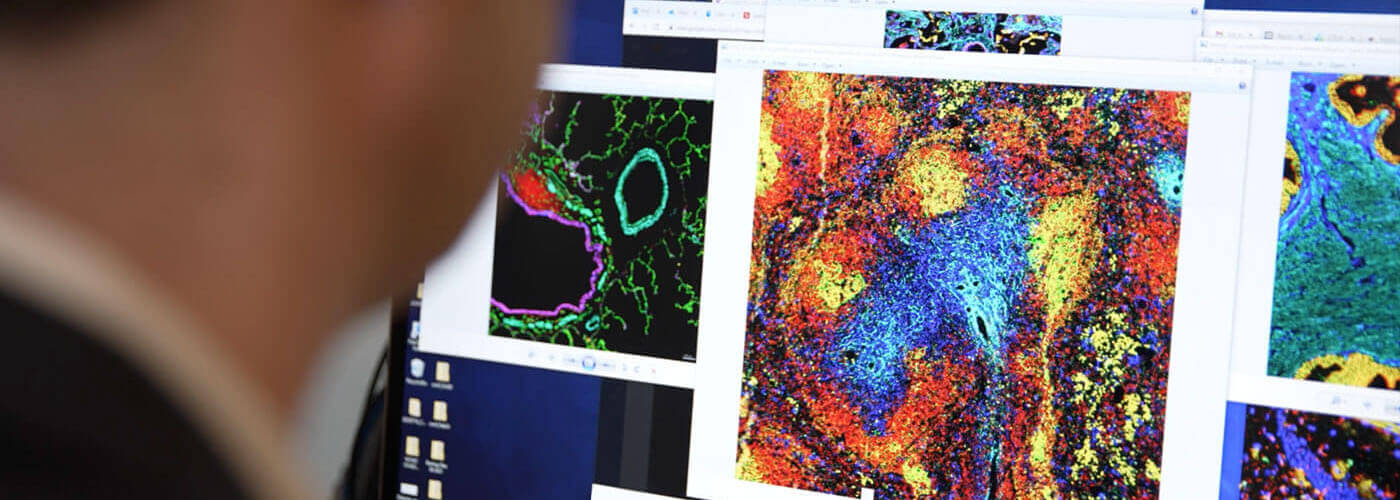
Unlocking the potential of spatial omics requires high-quality patient data at unprecedented scale.
By bringing together spatial omics, multiomics and AI, MOSAIC is creating new opportunities to understand cancer biology and accelerate discovery.
By mapping the interactions between cells within the tumor microenvironment, MOSAIC aims to uncover new disease biology, identify more precise patient subtypes, and discover biomarkers and drug targets to enable more personalized medicine.


How will MOSAIC help us fight cancer?

New disease biology
- Integrated, multimodal analysis of the tumor in its native architecture
- A new understanding of the tumor microenvironment

New patient subtypes
- Identification of patients who are resistant or respond differently to certain drugs
- A better understanding of how tumor-immune cell interactions differ in those patients

New biomarkers
- Discovery of biomarkers that characterize patient subtypes
- Improved diagnostics, treatment decision and clinical trial design

New drug targets
- Discovery of patient-specific drug targets
- Development of more effective combination and personalized therapies

Matching the right patient to the right treatment
- Improved connection between patient biology and target discovery
- Prescription of personalized therapies to the right patients

Why spatial biology?
Spatial biology brings a new dimension to cancer research because it maps biological molecules to their location within a tissue, capturing the spatial context.
When combined with data from technologies like imaging and genomics, spatial omics contributes to a rich, multiscale understanding of disease mechanisms.